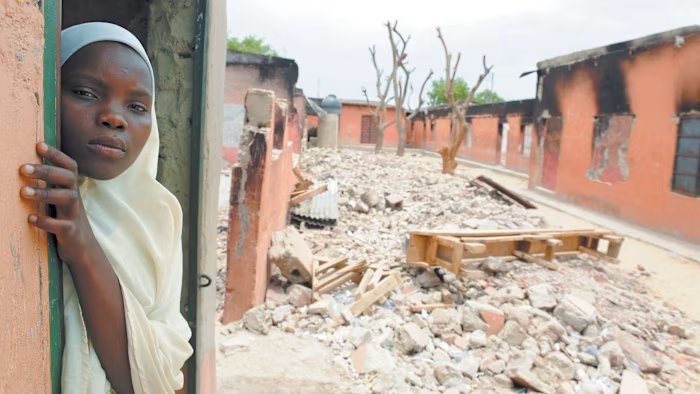
Aisha Mahmuda was 16 when men in military uniforms stormed her school in Dapchi one unassuming March evening in 2018. The students had just finished their prayers when suddenly, chaos spread through the grounds — insurgents, kitted in Nigerian Army regalia, told the girls they were being evacuated for their safety. Confusion hardened into fear as the armed men guided them toward trucks, exploiting multiple entry points into the school and their near-perfect mimicry of real military personnel. The girls were told they were being taken to Damaturu in anticipation of a bandit attack on their school. Instead, they were driven through the night, deep into a forest firmly under ISWAP control. Over the two weeks that followed, Aisha and her classmates were physically abused, traumatized, and violently recaptured after a failed escape attempt before their eventual release.
Before Nigerians were forced to become familiar with terms like “school abduction” and “jihadist attack,” before Boko Haram became a global name and mass kidnappings became commonplace, Nigeria’s security crisis, though concerning, was not a national identity.
What insurgency looked like in Nigeria a few years ago now feels almost archaic, primitive. For years, conflict was fragmented — armed robbery along highways, low-scale communal clashes in the Middle Belt, and the Niger Delta’s early hostage-taking campaigns aimed at foreign oil executives in the late 1990s. Violence existed, but it was not yet the sprawling, multi-layered ecosystem of insurgency, banditry, and organised crime that now defines the country.
The 2014 abduction of the Chibok girls served as a rupture: an event that captured the world’s attention and forced Nigerians to confront the fragility of their own security architecture. But Chibok was not the beginning of Nigeria’s reign of terror. Before that, Boko Haram had already transformed from Mohammed Yusuf’s small Islamist sect into a full-blown insurgency after his death in police custody in 2009. The ideology — encapsulated in the phrase “Western education is forbidden” — gave the group a distinct philosophical mission. In the decade since Chibok, what insurgency means in Nigeria has undergone a kind of evolution. What once was ideologically driven has splintered into a complex marketplace of violence.
Today, the country is contending with a lattice of armed actors: Boko Haram and its offshoots (such as ISWAP) in the North-East; “bandit” gangs in the North-West; the gradual creep of jihadist groups like al-Qaeda-affiliated JNIM and ISSP along porous borders; splinter formations such as Ansaru, Lakurawa, and Mahmuda; and the long-burning herder–farmer conflicts across central states. The South-East has not been spared. There, insecurity is often flattened into a single narrative around IPOB (Independent People of Biafra) and its armed wing, ESN (Eastern Security Network), but in reality it is sustained by a loose mix of “unknown gunmen,” cult groups, communal clashes and attacks on security agents, with parts of Imo, Anambra, Enugu and Ebonyi slipping into what are effectively ungoverned spaces. Each strand of violence emerged from distinct local conditions, but together they form a nationwide security emergency — literally, as declared by the president in 2025.
The timeline of Nigeria’s abductions since 2014 reads almost like an evolution chart. Banditry in the North-West, once limited to petty theft and roadblock robberies, mutated rapidly and escalated until kidnapping became a transactional weapon. By 2016, as cattle stocks diminished and weapons flooded into the region — much of it fallout from Libya’s political collapse — kidnapping had surpassed cattle rustling as the most profitable criminal enterprise.
This transformation was mirrored in the North-East, where Boko Haram fractured. Its most infamous faction, led by Abubakar Shekau, killed and displaced thousands — Chibok was only the most visible. Another, ISWAP, peeled away in 2016, accusing Shekau of violating Islamic doctrine by killing Muslims. ISWAP — which fancies itself the more lenient group — prioritised attacks on military and government targets, even as its internal turf war with Boko Haram persisted, culminating in Shekau’s suicide during a confrontation. Meanwhile, Ansaru shifted its operations towards central Nigeria and was linked to the 2022 Abuja–Kaduna train attack. Emerging names like Lakurawa — often mischaracterised as “new” — reflect the adaptive strategies of Sahelian jihadist groups entrenching themselves along borders, blurring the line between insurgency and banditry.
Mass abductions — more lucrative than individual ones and more likely to attract ransom payments — have become routine. Between 2019 and 2023, Nigeria accounted for 52% of West Africa’s organised-political-violence-related abductions, peaking in 2023. Beacon Security & Intelligence Limited (BSIL) a Nigerian entity focused on risk management and intelligence for the Sahel region, recorded a 30.43% increase in abductions between the first half of 2024 and 2025. In 2025 alone, incidents in Kaduna, Kebbi, Borno, Sokoto, Kwara, and Niger have resulted in hundreds of victims: pupils, women, church worshippers, and entire communities. The geography has widened, the targets diversified, and the motives have become increasingly financial.
Schools, in particular, have become symbolic battlegrounds. More than 1,680 students have been abducted since 2014, and schools in at least nine states are now fully or partially closed out of fear. The Safe Schools Initiative — launched in 2014 — has largely failed to protect children. Nigeria already hosts the world’s highest number of out-of-school children: 10.5 million in total, with 66% concentrated in the North-West and North-East — 60% of whom are girls. Terrorism has only accelerated the crisis. More than 600 teachers were killed and over 19,000 displaced between 2012 and 2016, according to national reports. This has contributed to an education landscape shaped by fear, interrupted learning, and entire generations of children pushed out of classrooms.
The human cost of this shift is visible, measurable, and tragic. Around 110 schoolgirls were abducted in the 2018 Dapchi attack. While many were eventually released, several died in the chaos of the abduction and others in captivity. Those who returned had watched their classmates lose their lives, and although they survived, many were so deeply traumatised that they simply could not bring themselves to go back to school. The region remains as unsafe today as it was at the time of the abduction, if not more so, and Aisha, like many others in her community, has little faith in the Nigerian government’s ability to protect them.
This is the great tragedy of Nigeria’s enduring security crisis: that the state cannot carry out its most basic constitutional responsibility: the security and welfare of its citizens. Each new abduction undermines the social contract, and each delayed response reinforces the perception of a state that reacts rather than protects. As violent groups grow richer off ransom payments — sometimes even facilitated by state actors — the dynamic becomes even more lopsided.
And the distrust isn’t just directed at the government. Insurgency has deepened ethnic and religious divides. Conflicts with ethnic undertones, particularly the Fulani herder–farmer clashes, have intensified fear and bigotry. Entire communities have come to see one another as existential threats. Northerners are regarded with suspicion, and Nigeria’s Christian population increasingly expresses fear of targeted attacks. International narratives — especially from U.S. commentators touting a “Christian genocide” — add fuel to an already volatile landscape. The Nigerian government’s posture remains largely reactive — swift condemnations, military deployments, and legislative proposals that substitute the portrayal of severity for effectiveness.
Attempts at regional security cooperation have been uneven. The Multinational Joint Task Force — designed to coordinate operations across Nigeria, Niger, Chad, and Cameroon — has been hampered by inconsistent commitment, weak command structures, and chronic funding delays. Jihadist factions, better equipped and more adaptable, exploit these gaps. And as the AES alliance (Burkina Faso, Mali, Niger) disengages from ECOWAS, West Africa’s already porous borders grow even more vulnerable. Military spending continues to rise — N4.91 trillion allocated in the 2025 budget — but it remains unclear whether the Nigerian armed forces are receiving this equipment at the pace and scale required.
Security experts have repeatedly warned that without a proactive shift — intelligence-led policing, strengthened regional alliances, properly equipped armed forces, and the rebuilding of trust within communities — the cycle will continue. Nigeria’s borders will remain open arteries through which jihadist groups move, recruit, and entrench themselves. Rural populations will remain vulnerable. Schools will remain battlegrounds. And insurgency will remain both a symptom and a driver of deeper national dysfunction.
2027 is approaching quickly. Nigerians will flock to the polls in a country where any citizen can find themselves a potential abduction victim. The question is whether the next administration will treat insecurity as a structural problem requiring structural solutions, rather than episodic violence requiring episodic reactions.