News & Politics
M23 Rebels Seize Uvira as US-Brokered Peace Deal Falters
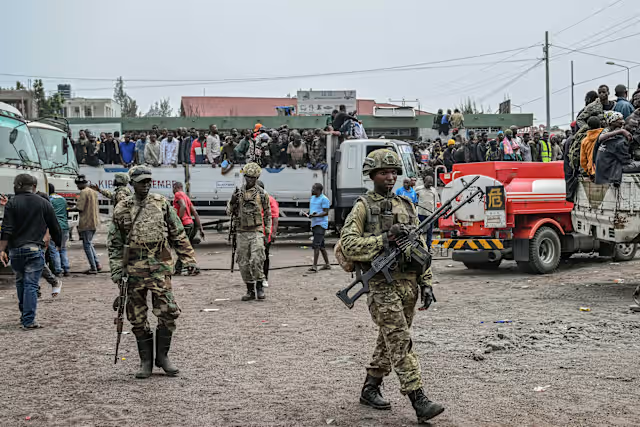
Rebel fighters from the M23 movement pushed into Uvira on Tuesday, breaching the last major government-held city in Eastern Democratic Republic of Congo and triggering a mass flight of civilians and soldiers into neighbouring Burundi, according to residents and security officials. The offensive, marked by heavy artillery fire and chaotic evacuations, has cast immediate doubt […]
By
Naomi Ezenwa
3 months ago
Rebel fighters from the M23 movement pushed into Uvira on Tuesday, breaching the last major government-held city in Eastern Democratic Republic of Congo and triggering a mass flight of civilians and soldiers into neighbouring Burundi, according to residents and security officials. The offensive, marked by heavy artillery fire and chaotic evacuations, has cast immediate doubt over the viability of the peace accord that US President Donald Trump brokered just last week between Congolese President Félix Tshisekedi and Rwanda’s Paul Kagame.
Burundi, overwhelmed by the scale of the influx, shut its border as thousands of Congolese poured across, even as its government insists the decision should not be misconstrued as a shift in allegiance. Bujumbura has several thousand troops deployed in eastern DRC in direct support of Tshisekedi’s forces, and President Évariste Ndayishimiye had flown to Washington only days earlier to witness the signing of the accord Trump hailed as a diplomatic “miracle.” Now, as M23 columns advance with what Burundian officials say is unmistakable Rwandan reinforcement, that agreement already looks like a casualty of the region’s entrenched distrust.
“This is a slap in the face… a middle finger,” Burundi’s Foreign Minister Edouard Bizimana said, describing the offensive as a humiliation not only for the signatories but “first and foremost for President Trump.” His anger reflects a sentiment many in the region quietly share: that the spectacle of foreign-brokered peace deals means little when armed groups move with an autonomy that belies paper commitments.
On Tuesday, the United States, European Union and eight European governments issued a joint statement accusing Rwanda of supporting the renewed rebel advance — echoing the findings of UN experts who say Rwanda’s army maintains “de facto control of M23 operations.” They urged the Rwanda Defence Force to halt all offensive activity and withdraw from eastern Congo, warning that the violence poses a destabilising threat to the entire Great Lakes region.
For Congo, the timing is particularly damning. The latest offensive comes nearly a year after M23 seized Goma and Bukavu, tightening its grip over the mineral-rich east. The group is not a party to the US-brokered deal and is instead engaged in separate Qatari-led mediation, underscoring how fragmented the region’s conflict-resolution efforts have become. In a sombre national address, Tshisekedi accused Rwanda of “deliberate violations” of the new accord, warning that Congo is being subjected to a “proxy war” over strategic territory rich in critical minerals essential to global supply chains.
Rwanda, in turn, accused Congo and Burundian troops of bombing villages near its border, prompting more than 1,000 civilians to flee into Rwandan territory. The trading of accusations is a familiar prelude to escalation in a conflict that has defied resolution for more than three decades, dating back to the aftermath of the 1994 genocide.
What is perhaps most telling is not simply the collapse of yet another peace effort, but the structure of the effort itself. That Washington had to step in and impose a framework on two African heads of state is itself an indictment of the regional system meant to govern such crises. The African Union — whose mandate explicitly covers the prevention and resolution of continental conflicts — again finds itself relegated to a reactive observer, issuing statements, welcoming foreign interventions and offering little beyond diplomatic platitudes.
As Uvira falls under rebel fire and thousands flee yet another cycle of violence, the stagnation of the African Union’s peace architecture is impossible to ignore. Over three decades of conflict, countless agreements, and not a durable solution in sight. The cost of that vacuum is borne, as always, by civilians: the ones trekking across sealed borders, fleeing guns that never seem to fall silent.