Feature
How 2016 Reshaped The Sound and Ambitions of Afrobeats
Days into 2026, quips about 2026 being the new 2016 began to circulate on social media. In a sense, this gestured at Gen Z’s relentless penchant for nostalgia, a phenomenon that’s as palpable in the music of the day as it is in fashion. It also doubles as a pun, or a meme, if you […]
By
Chibuzo Emmanuel
2 months ago
Days into 2026, quips about 2026 being the new 2016 began to circulate on social media. In a sense, this gestured at Gen Z’s relentless penchant for nostalgia, a phenomenon that’s as palpable in the music of the day as it is in fashion. It also doubles as a pun, or a meme, if you will—both years share nearly identical digits. In recent days, however, the notion of this year being a callback to 2016 has started to take on increased seriousness. Pay attention to the comment section of any major fashion house or publication, and you will find people enthusiastically describing trends as throwbacks to 2016. The internet is also awash with throwback pictures from 2016, shared by celebrities and everyday individuals alike. While this trend is driven by nostalgia, it also reflects a broader yearning for simpler times—before social media feeds became minefields of rage bait, radioactive discourse, and AI slop; before algorithm-curated playlists pushed human music curation to the margins.
The Afrobeats landscape has not been spared from 2016-fever, with artists and industry professionals—everyone from DJ Tunez to Donawon—dredging up grainy photos and anecdotes from that period. Music blogs and publications have also ridden the wave, saturating social media with clips and pictures from 2016. All of these prompts a few questions: What is 2016 to Afrobeats history? What were the cultural forces shaping the music and the zeitgeist of the time? And what does this reveal about the current state of the music landscape?
One of the most prominent shifts heralded by 2016 was the marked slowing of Afrobeats. In 2015, while Afrobeats still largely bore a gritty, boisterous texture, softer interpretations of the genre were beginning to gain purchase. In June of 2015, Olamide’s Melo Melo, produced by Pheelz, with its subdued tempo and elegiac tone, became one of the standout tracks from Eyan Mayweather, an album replete with thumping tracks in which he alternates between asserting his hegemony over the Hip Hop scene and threatening his enemies with retribution. By July that year, a surprise remix of Wizkid’s Ojuelegba featuring Skepta and Drake vaulted into global acclaim.
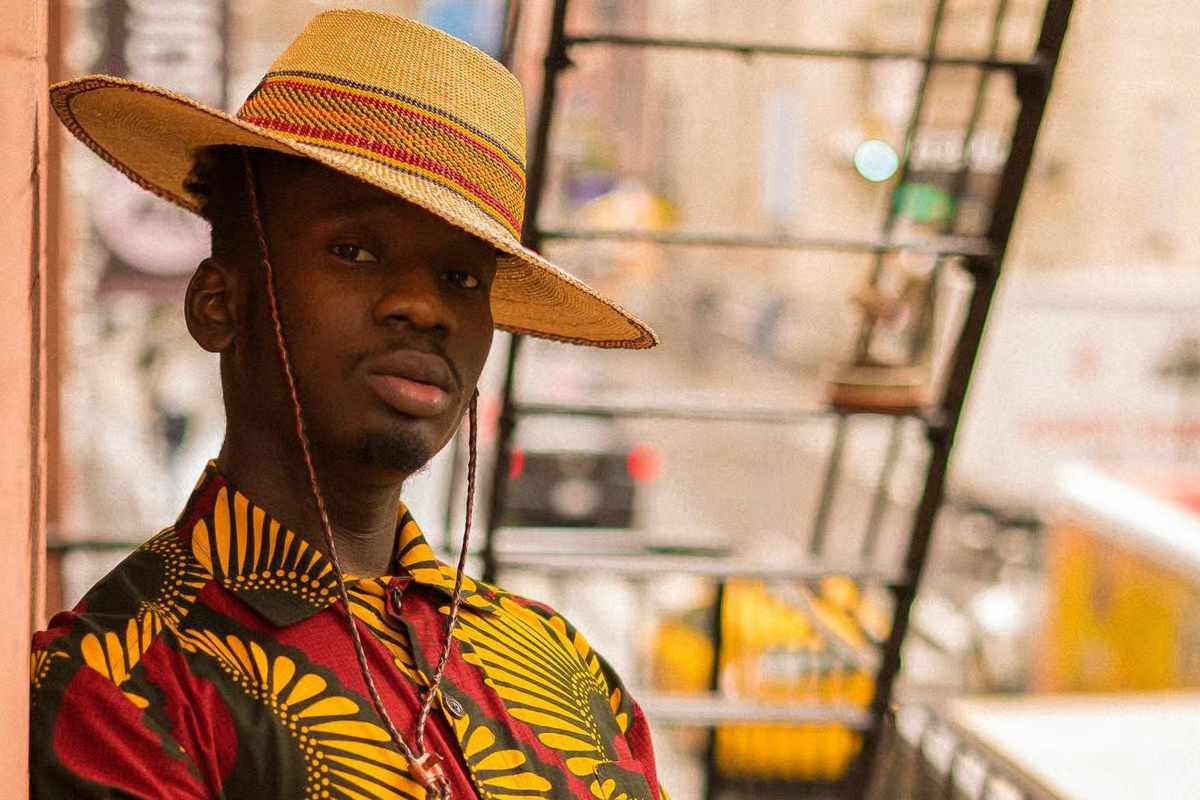
Nonetheless, these songs were outliers or perhaps portents of what would only start to take shape in 2016 when Mr Eazi, a lanky, straw-hat donning singer, with skin the color of cocoa and vocals perfectly calibrated for poignant romantic ballads, emerged on the Afrobeats scene with a fresh perspective on the genre. He christened this sound, informed by the laidback rhythms of Ghanaian highlife, as Banku Music, after the popular Ghanaian meal. Mr Eazi, raised in the crucible of Lagos’ cosmopolitan ethos and frenetic pulse, had moved to Ghana at 16 to pursue a university degree. Upon moving to Ghana, he suddenly found himself in a wildly different culture from his Lagos upbringing. “I was a little bit of a hot head before I moved to Ghana; I was becoming a rascal,” He says in an interview with WePresent. “But going there developed my temperament because Ghana is very calm and things are moving.”
He quickly began experimenting with fusions of Nigerian and native Ghanaian sounds, culminating in Banku Music, a calmer variation of Afrobeats that fuses the staid rhythms of Ghanaian highlife with chord patterns and progressions peculiar to Afropop. In 2016, after years of honing his sound, he rose to public acclaim through songs like Bankulize remix featuring Burna Boy and Leg Over, which cemented his ascent to stardom. It was also in this period that Mr Eazi coined the now-ubiquitous “Detty December” phrase, which he described as a shorthand for “Going back to your roots, having fun and enjoying life intentionally.” Runtown, who was by then one of the most prodigious artists on the Afrobeats scene, also began flirting with Banku, culminating in his 2016 smash hit Mad Over You. What made the rise of the Banku Music especially pivotal is that it arrived at a time when Afrobeats was poised for global expansion but faced an existential challenge.
For years, leading Afrobeats artists had attempted to cross over into international markets with little success. In 2011, D’Banj signed to Kanye West’s GOOD MUSIC. Many at the time were convinced the move would foment the genre’s long-awaited crossover moment. What we got instead was a Kanye West appearance in the video of Oliver Twist, and not much else. P Square’s crossover attempts were somewhat more successful, yielding songs like Beautiful Onyinye featuring Rick Ross and the T.I-assisted Ejeajo. Their gambits, however, failed to produce a crossover hit. While these attempts, by artists like D’Banj and P Square, failed to produce the desired results, they softened the landing for the artists in tow, and by 2016, the stars seemed to have aligned for what would come to be known as the “Afrobeats to The World Movement.”
The success of Wizkid’s Ojuelegba remix featuring Drake and Skepta had fostered hope that Afrobeats could become the global sensation that pioneers had long dreamed of. But by 2016, when Drake teamed up with Wizkid and Kyla for an Afrobeats song called One Dance that dream went from a distant possibility to an imminent reality. The song peaked atop the Billboard Hot 100 and was the most-streamed song in the world for a while, providing concrete proof, to artists and investors, of Afrobeats’ international appeal. Soon labels like RCA and Universal Music Group began a race to sign some of Nigeria’s vanguard artists. Wizkid and Davido were among the first to score major international deals, and soon others would follow.
This apparent windfall came with a fresh set of challenges. Many of these new labels felt the variety of Afrobeats of the era was still unrefined—too fast, too busy, too percussion-driven—for a global audience. And so many of them paired their fresh Afrobeats signings with foreign producers in hopes that they would gratuitously arrive at sounds capable of straddling the local and foreign markets. Davido’s Son of Mercy is one such experiment, released in 2016, under the aegis of Sony Music. Reflecting on the project, the 33-year-old singer has said: “When I first came they put me with some producers but it didn’t work out. We dropped an EP under Sony which was my first project but it felt like a failure to me.”
It was against this backdrop that Mr Eazi’s tempered, melodious take on Afrobeats arrived, providing a template that would serve the industry in the years to come. The following year, Tekno’s Pana and Wizkid’s Manya featuring Mut4y would light up dance floors at home and abroad. Davido’s If and Fall didn’t just electrify fans in Nigeria but crossed over to international audiences. It’s impossible to fully grasp Afrobeats 2016 story without appreciating the crucial role Runtown’s Mad Over You played. Beyond its commercial success at home and internationally, the song proved that Mr Eazi’s Banku sound could find alternative expressions better suited to the Nigerian palette. One could argue that it prefigured the “pon pon sound,” a style of Afrobeats, defined by staccato percussive elements and gentle rhythms, which artists like Davido and Peruzzi would wield, to great success, in the years to come.
The notion of 2026 being a callback to 2016 certainly can be ascribed to social media’s tendency for fomenting nostalgia-addled trends. Nonetheless, it hints at a fundamental truth. Once again, the genre finds itself at a crucial inflection point. Years of monotony have culminated in an existential moment for the genre: Afrobeats to the world seems to have bottomed out and the spoils of the movement’s heyday appear to be the sole preserve of a select few. As all this unfolds, a new cohort of iconoclasts from the underground scene—Zaylevelten, Mavo, Luwa, Artsalghul, Ar4, and Monochrome, are shattering extant rules in pursuit of new creative vistas. Will their efforts prove as crucial as those of 2016’s innovators? Only time will tell.