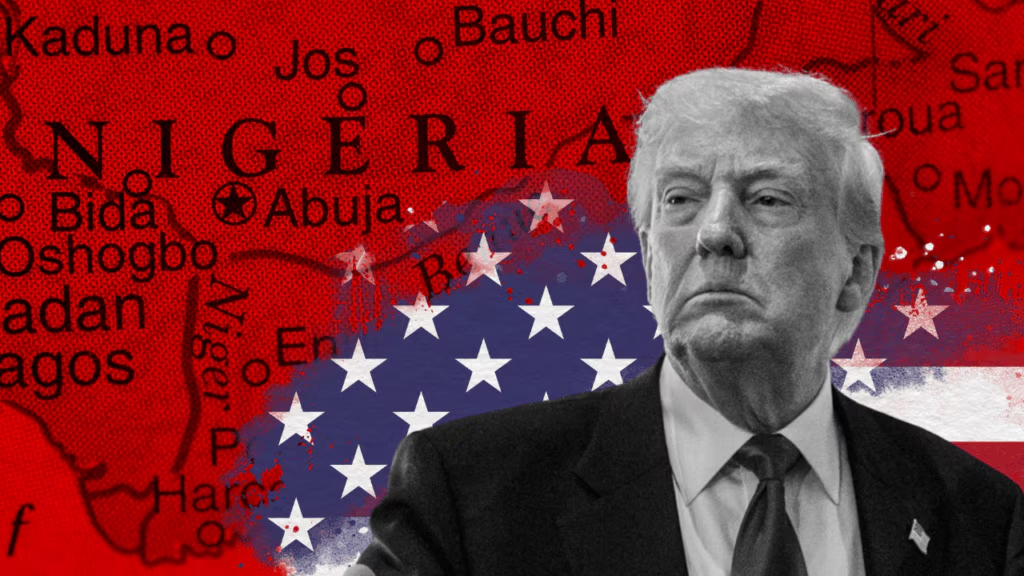
Following President Trump’s call to action and the redesignation of Nigeria as a Country of Particular Concern (CPC), the House Appropriations Committee and the House Foreign Affairs Committee delivered a joint report on the persecution of Christians in Nigeria to the White House. The findings followed an investigation headed by U.S. Representative Riley Moore, which included interviews with witnesses, a hearing and roundtable, two on-the-ground assessments through bipartisan congressional delegations to Nigeria, and a close partnership with the Trump administration.
On Monday, 23rd February, the report was presented to the White House.
In considering the report, it must first be stated that its legitimacy is gravely diminished by the fact that it is based on misinformation repeatedly presented as fact. Even after being corrected multiple times, the U.S. continues to frame Nigeria’s insecurity crisis as a Christian genocide. That insistence alone undermines the premise of the report, which rests on a narrative that is, at best, deeply misleading and, at worst, deliberately inflammatory.
If the U.S. were attempting to assist Nigeria with the insecurity crisis as a whole, some of the recommendations in the report might be acceptable. Quite a number of them would, in fact, be beneficial. However, the Christian genocide framing is itself problematic. It distorts the nature of the crisis and heightens tensions in an already fragile environment. Again, one must ask: who appointed America the defender of Christianity globally?
Several experts have acknowledged that Nigeria faces serious security challenges, but they argue that the claim of a deliberate, state-backed extermination of Christians is “inaccurate and harmful.” Analysts and survivors alike agree that Nigeria’s insecurity cuts across religious and ethnic lines. It is driven less by theology than by resource competition, poverty, climate change, weak governance, and the proliferation of armed groups operating in poorly governed spaces.
There is, strictly speaking, no Christian genocide. Yet it is not difficult to understand why the U.S. insists on this framing. By positioning himself as the defender of global Christianity, Trump revives a narrative that plays well with his conservative evangelical base. It distracts from domestic failures, shores up waning political support, and reasserts a long-standing tradition of American — specifically white Christian — exceptionalism. His moral grandstanding on Nigeria’s supposed “Christian genocide” reads less like principled advocacy and more like political calculation.
Beyond image rehabilitation, the genocide narrative provides the U.S. with a convenient point of entry into Nigeria’s domestic affairs. It creates space to extend influence and shape policy in ways that align with American strategic interests. Many of the report’s recommendations make this intention difficult to ignore. Meanwhile, Nigerian leaders appear either too complacent or too self-serving to interrogate the broader implications. If Trump’s opportunism is predictable, Nigeria’s vulnerability to it is self-inflicted.
After making the sweeping and unsubstantiated assertion that Nigeria is the deadliest place in the world to practise Christianity, the report turns to the continued existence of Sharia law, highlighting how it contravenes human rights. That contravention, in certain applications, is a fact. For years, activist groups have drawn attention to the ways in which some of these laws conflict not only with international human rights norms but also with the Nigerian Constitution. Successive governments have largely failed to resolve these contradictions, choosing instead to leverage the situation for their own political ambition.
The Nigerian Constitution prohibits the federal and state governments from adopting a state religion and provides a strong legal foundation for freedom of religion or belief. Section 38 of the 1999 Constitution guarantees every Nigerian the right to “freedom of thought, conscience and religion,” including the right to express views that others may consider blasphemous. The state is tasked with protecting that right.
Despite these protections, Section 204 of the Criminal Code (applied in southern states), Section 210 of the Penal Code (applied in northern states), and Sharia codes in twelve northern states retain provisions criminalising blasphemy, with penalties ranging from significant prison terms to, in some cases, the death penalty.
Nigeria’s catalogue of blasphemy-related cases does little to strengthen her position internationally. Mubarak Bala, an atheist in Kano, was released last year after spending more than four years in prison. In 2022, he was convicted for social media posts deemed blasphemous against Islam, after already spending two years in detention before trial. In 2020, Omar Farouq was sentenced to ten years’ imprisonment on a blasphemy charge. That same year, singer Yahaya Sharif-Aminu was sentenced to death by hanging by a Sharia court in Kano for a similar offence. In 2022, Deborah Samuel, a student in Sokoto State, was brutally murdered after being accused of blasphemy.
These cases are disturbing and demand serious domestic reform. They reveal legal inconsistencies and governance failures. They do not, however, substantiate the sweeping claim of a coordinated Christian genocide.
The report proceeds to strongly suggest that the U.S. and Nigeria form a new strategic partnership that will supposedly make both countries safer, stronger, and more prosperous. It outlines recommendations on how such a partnership would operate.
As far as general security and religious freedom are concerned, several of these recommendations are sensible. They include commitments to eliminate jihadist activity in the region, provide humanitarian assistance to affected communities, facilitate the voluntary return of displaced persons, and strengthen early-warning mechanisms to prevent attacks and kidnappings. On paper, these are constructive proposals.
However, American foreign policy on the continent suggests that such offers should be approached with caution. History has shown that American assistance rarely arrives without strategic calculation.
Indeed, several other recommendations raise concerns about ulterior motives. If this is a partnership aimed at protecting Nigerian Christians and eliminating jihadist activity, it should remain focused on that objective. What does “further economic cooperation” with the U.S. have to do with safeguarding Christians? Why should Nigeria be encouraged to “counter adversaries” in the region such as the Chinese Communist Party and the Russian Federation? Whose adversaries are these? And what do they have to do with the alleged goal of protecting vulnerable communities in Nigeria?
The report specifically recommends divesting from Russian military equipment in favour of American hardware through sales and financing arrangements. It also frames counter-terrorism cooperation as necessary to eliminate Foreign Terrorist Organizations that pose a direct threat to the American homeland. At that point, the priorities become clearer. The language shifts from humanitarian concern to strategic repositioning.
The recommendations conclude with calls for support from Hungary, France, and the United Kingdom. The increasing involvement of multiple foreign actors in Nigeria’s domestic security environment should prompt serious reflection. Sovereignty cannot become collateral damage in the pursuit of external alliances.
This brings us back to a fundamental question: in whose interest is this report written? Is it in the interest of Nigeria, or is it primarily in the interest of the United States — and more specifically, the Trump administration?
The Nigerian government must engage this situation with pragmatism and foresight. It could easily spiral, particularly given Trump’s unpredictability. The alarming Christmas Day airstrikes serve as a cautionary example of how quickly narratives can diverge.
On December 25th, 2025, the U.S. launched what Trump described as “powerful and deadly” strikes against militants linked to the Islamic State group in north-western Nigeria. According to U.S. military statements, camps in Sokoto State near the border with Niger were targeted. Casualty figures remain unclear, though both U.S. and Nigerian officials confirmed that militants were killed.
Nigerian Foreign Minister Yusuf Maitama Tuggar characterised the operation as a joint effort planned over time using Nigerian intelligence, and stated that it had nothing to do with religion or the timing of Christmas. Trump, however, told Politico that he delayed the strikes to make them “a Christmas present,” claiming, “They didn’t think that was coming, but we hit them hard. Every camp got decimated.”
This divergence in narratives is troubling. It does not project the image of a carefully harmonised partnership. Instead, it suggests unilateral action framed for domestic political consumption, with Nigeria cast in a secondary role within its own security landscape.
From the tone and direction of this report, one conclusion emerges: what is presented as defence may, in practice, become leverage. And if that trajectory is not carefully managed, it risks becoming less a solution to Nigeria’s insecurity crisis and more a blueprint for deeper external entanglement — a recipe, ultimately, for disaster.